



When Brand Trademarks Mean Something – and When They Don’t
Every appliance brand has a trademark. Most of them are dressed-up marketing – a fancy name for something every competitor also does. Some of them are real engineering distinctions. The challenge for buyers is telling which is which, especially when the brand-trademark vocabulary gets dense.
Laurastar’s central trademark is DMS – Dry Microfine Steam. The brand has built its entire identity around this technology. The price premium is justified by it. The product range is organised around it. So the natural question is: is DMS actual engineering, or is it well-marketed steam?

What Steam Actually Is, Before the Marketing
To evaluate DMS honestly, you need to understand what ordinary steam from an ordinary iron is doing. When water boils, it produces water vapour – steam – that’s typically saturated, meaning the steam carries microscopic water droplets in suspension. Saturated steam is wet. It’s hot. It penetrates fibres reasonably well. But the suspended water droplets can leave marks on fabric, especially silk, satin, and certain wools.
Dry steam – in the strict engineering sense – is steam that’s been superheated above the saturation point, so the water droplets have fully transitioned to gas. Dry steam is hotter, drier, and meaningfully better at penetrating tightly-woven fabric without leaving moisture residue. It’s the steam type used in industrial pressing, certain food sterilisation processes, and high-end laundry equipment.
What “Microfine” Specifically Claims
The “microfine” part of DMS refers to the particle size distribution of the steam at the point it exits the soleplate. The technology claim is that Laurastar’s boiler and steam-delivery path produce steam particles around 4-5 microns in diameter – significantly smaller than typical iron steam, which is closer to 30-50 microns.
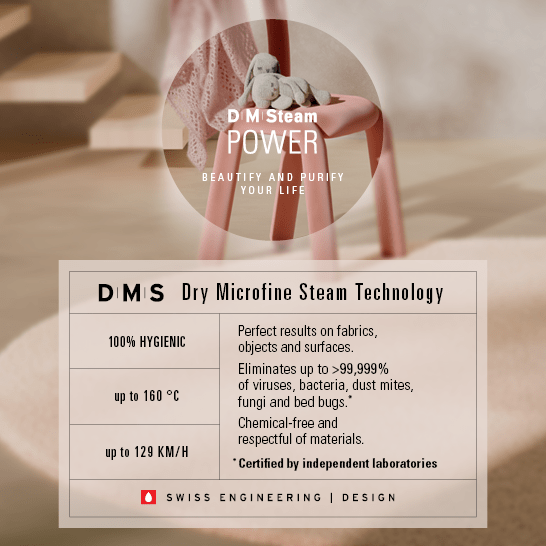
Why does particle size matter? Two reasons. First, smaller particles penetrate fabric fibres more effectively – they get into the weave rather than condensing on the surface. Second, smaller particles cool more slowly, which means the steam stays hot enough to do useful work for longer after it leaves the soleplate. Both effects are real. Both are measurable. And both are what makes the visible pressing result different from a standard iron.
The Independent Engineering Check
The honest question for any trademark claim is: do independent measurements support the marketing? In the case of DMS, the answer – based on the engineering literature on steam particle size in textile applications – is reasonably yes. The combination of high-pressure boilers, micro-engineered steam-exit channels, and the operating temperature Laurastar uses does produce steam meaningfully drier and finer than what a domestic iron generates.
The Verdict on DMS as Engineering
DMS is a real engineering claim, not a marketing dress-up. The steam Laurastar produces is genuinely drier and finer than standard iron steam. The brand has been honest about the underlying physics. The price premium reflects the engineering that produces this difference – not just better packaging around the same technology.
What This Means Practically
The practical effects show up in three places. First, fabric care: silk, satin, and structured wool jackets that would normally need professional pressing can be safely pressed at home. Second, ironing speed: dry steam penetrates faster, so a typical shirt takes 30-40% less time. Third, the hygiene claim – the brand markets DMS as effective against dust mites and certain microorganisms, and the temperatures it operates at do support that claim.

Where the Marketing Outruns the Engineering
It would be unfair not to flag the parts where the marketing pushes harder than the underlying claim supports. The “kills 99.9% of viruses” framing, applied to all uses of DMS-based steamers, depends on contact time and temperature in ways that aren’t always achievable in domestic use. The “removes dust mites from soft furnishings” claim is genuinely supported, but only with sustained application that most users won’t actually do.
That’s the standard pattern with any well-engineered consumer product. The core engineering is honest. The marketing extends the claims a bit further than the engineering quite supports. Buyers benefit from knowing which parts are which.
The Take, Summarised
DMS is real engineering. The steam Laurastar produces is genuinely different from what comes out of a standard iron. The premium pricing reflects the technology, not just the brand. For buyers who iron regularly, care about delicate fabrics, or want a steaming tool that doubles as a hygiene tool, the DMS engineering pays off. For buyers who iron occasionally and don’t need the fabric-care precision, the technology is overkill – but the underlying claim is still honest.
