


Most surfers buy a wetsuit the same way they buy a phone – they go to a brand they recognize, pick mid-range, and hope for the best. That approach works, kind of. But when you’re talking about a piece of gear that directly controls how long you stay in cold water and how freely your shoulders move on a paddle-out, “kind of” starts feeling like a real compromise. O’Neill has been engineering wetsuits since 1952, which means their current line is the product of seven decades of iteration – not marketing polish.
The question worth asking is this: do those decades actually translate into meaningful differences between their product tiers? And if so, which tier makes sense for your water temperature and your skill level? This is an honest look at what the range actually delivers.
Where the Heritage Actually Matters
Jack O’Neill started gluing neoprene together in his San Francisco garage because he wanted to surf longer in the Pacific’s cold swells. That origin story is charming, sure, but it also explains something structural about how the brand develops products – they build from genuine cold-water need, not from fashion trends or boardroom decks. By the time the modern surf industry was commercializing heavily in the 1980s and 90s, O’Neill already had a thirty-year head start on understanding what fails in a wetsuit and why.
That history shows up in the current line in specific ways. The thermal lining technology in their premium suits, the seam-taping methodology, and the neoprene formulations are all outcomes of iteration through real-world conditions – not just lab testing. It’s a meaningful distinction. A lot of wetsuit brands license neoprene from the same Japanese manufacturers and differentiate only on cut and colorway. O’Neill has proprietary material agreements and seam constructions that are genuinely different at each tier.
The Reactor and Blueprint – Entry Points That Actually Work
Start from the bottom of the performance ladder. The Reactor is designed for warmer water – 15 to 20 degrees Celsius roughly – and for surfers who are still developing their relationship with the ocean. It delivers good thermal coverage for its price class. The seams are flatlock stitched, which means the thread crosses the seam externally. That construction is faster to produce and costs less, but it does allow a small amount of water ingress. In warm water, that’s fine. Water flushes in, warms to body temperature, and acts as insulation. In the North Sea in October, it’s the difference between a two-hour session and a forty-minute one.
The Blueprint moves a tier up. It targets the intermediate surfer who’s surfing year-round in moderate European conditions – think Portugal in winter, the Atlantic coast of France, or the Dutch coast in early spring. The seam construction is glued and blind-stitched, which closes off most of that water ingress. The neoprene is more flexible from the shoulders down, which matters enormously when you’re paddling through whitewash for twenty minutes before you reach a clean line. A stiff suit doesn’t just feel uncomfortable – it actively costs you energy and range of motion on the paddle.
> 20°C: 2mm shorty or thin full suit (Reactor range)
15-20°C: 3/2mm full suit (Blueprint, Hammer)
10-15°C: 4/3mm with taped seams (Psychotech, Hammer)
< 10°C: 5/4/3mm hooded setup (Hyperfreak with hood accessory)
The Hammer – Where Cold Water Gets Serious
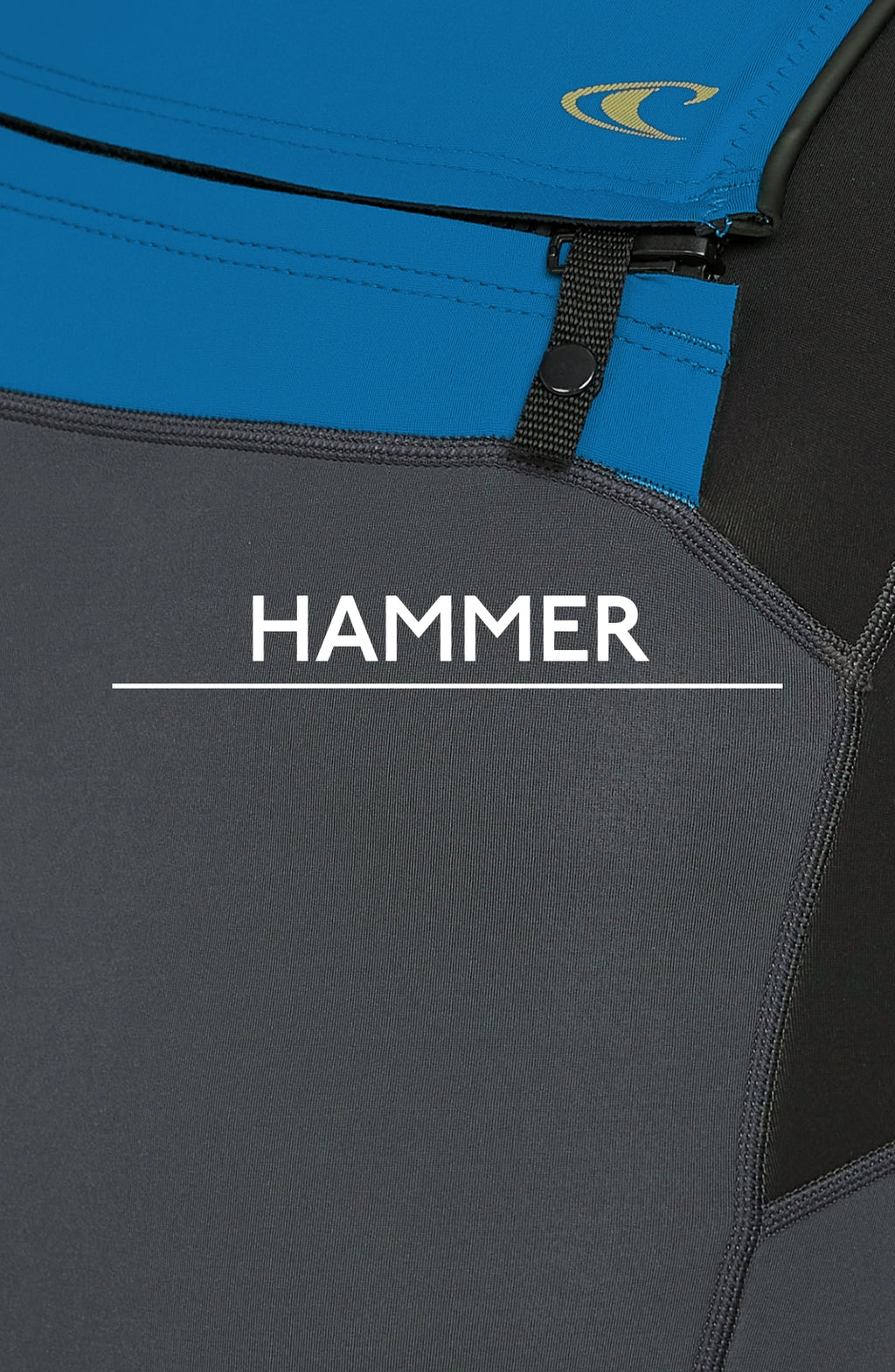
The Hammer is, in my reading of the range, the suit where O’Neill’s engineering philosophy becomes most visible. It’s designed for cold-water surf – the kind of conditions you encounter in Northern Europe, Ireland, Iceland, or the Pacific Northwest. The thermal lining is denser and more aggressive than anything in the Blueprint tier. The seams are fully taped internally, which eliminates water ingress almost entirely rather than just reducing it.
What makes the Hammer interesting is how it handles the flexibility-insulation tradeoff. Warmer suits are more flexible because thinner neoprene bends more easily. Cold-water suits are thicker, which historically meant stiffer shoulders and arms. O’Neill’s approach with the Hammer is to use a stretch-mapped panel layout – different thicknesses in different zones – so that the panels requiring most movement use thinner, more pliable neoprene while the core panels retain full thermal mass. The result is a suit that feels warmer than you’d expect from its flexibility profile, or more flexible than you’d expect from its warmth rating, depending on how you look at it.

Psychotech and Hyperfreak – The Performance Tier Gap
The Psychotech sits between the Hammer and the Hyperfreak. It uses a thermal lining called FireCell – a reflective material that captures radiated body heat and redirects it back toward the skin. The science is legitimate: your body radiates heat constantly, and most wetsuits let that energy dissipate. A reflective lining cuts that loss. Whether that translates to a meaningfully longer session depends on your body’s own heat generation and the water temperature, but it’s not marketing fiction. It works.
The Hyperfreak is a different proposition entirely. This is O’Neill’s top-tier performance suit, and it’s engineered for surfers who surf seriously – competitive or otherwise. The neoprene compound is different from everything lower in the range: lighter, more buoyant, and dramatically more elastic. The chest zip closure system is tighter and more water-resistant than any back zip, and the seam integration is designed to minimize any bulk that could restrict movement. When you paddle in a Hyperfreak for the first time after wearing a Blueprint or Hammer, the difference is genuinely startling. The shoulder freedom is in a different category.
That said – and this is the honest part – the Hyperfreak is a precision tool, not an all-purpose instrument. The same lightweight neoprene that makes it feel incredible in the water is less durable under the kind of casual abuse that intermediate suits absorb without complaint. If you’re the sort of surfer who rinses properly every session, stores flat, and treats your suit with something approaching respect, the Hyperfreak rewards that care. If you’re throwing it in the boot of a car still wet and half-salted, the Blueprint will outlast it considerably.
The shoulder freedom in a Hyperfreak is in a different category – but that lightness comes with a trade-off in durability that casual users should factor into the decision.
Skill Level vs Water Temperature – The Two Variables That Should Drive the Decision
Here’s a reframe that might help. Most wetsuit buying decisions start with price and end with brand recognition. The two variables that should actually drive the choice are water temperature and your physical output in the water.
Water temperature determines the thermal spec you need – the mm rating and seam construction. That’s non-negotiable physics. Skill level determines your physical output. Beginner surfers spend a lot of time sitting in the lineup, paddling inefficiently, and waiting. Advanced surfers paddle harder and more frequently. A higher physical output generates more body heat. So an advanced surfer can comfortably wear a lighter suit in the same water temperature as a beginner who needs a warmer one. It’s not about ego or status – it’s about how much heat your body generates during a session.
This means the Hyperfreak isn’t necessarily “the best” suit for all conditions. It’s the best suit for a physically active, technically accomplished surfer in moderate-to-cold water. A beginner who buys a Hyperfreak for cold European water might actually be colder in it than in a Hammer, because the Hyperfreak’s warmth relies partly on the wearer generating significant heat through paddling output. Counterintuitive, I know – but it’s a real dynamic.

The Honest Assessment
Seven decades of wetsuit development has produced a range with real, measurable differences between tiers. The Reactor and Blueprint serve distinct temperature ranges with appropriate construction methods. The Hammer is genuinely engineered for cold-water durability. The Psychotech adds legitimate thermal technology. The Hyperfreak delivers performance flexibility that is objectively superior to anything below it in the range – but it does so at the cost of durability and with the implicit requirement that the wearer generates enough heat to leverage it.
The one admitted flaw across the range – and it applies to O’Neill as much as any premium wetsuit brand – is that the top-tier suits require care that the packaging undersells. The Hyperfreak in particular will disappoint you in two to three seasons if you treat it like a Reactor. That’s not a design failure, exactly. But it’s something the brand could be more direct about, rather than leaving surfers to figure it out after the fact.
Buy for your water temperature first. Match the suit to your physical output and surfing frequency second. Let price follow from those two decisions rather than lead them. That’s the framework O’Neill’s own range is built around – it just takes a bit of reading between the lines to see it.
