


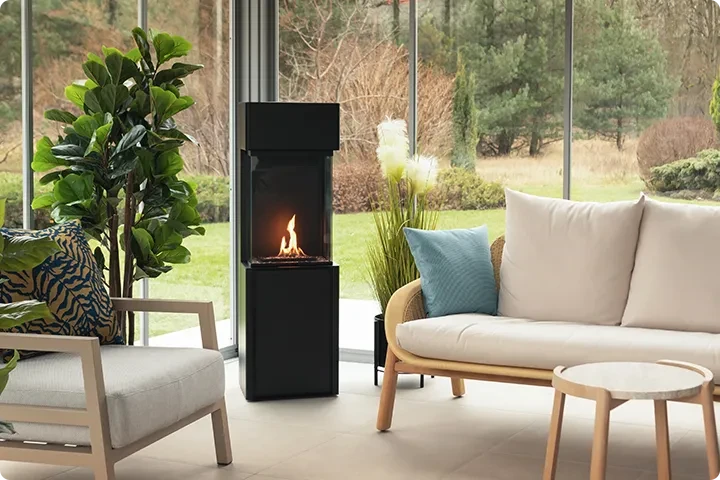
There is something deeply comforting about a fire. The flicker, the warmth, the way the room seems to slow down the moment it comes alive. Generations of people have gathered around flames for exactly that reason. But here is the thing nobody talks about at those cosy gatherings – wood fires are quietly doing a number on your lungs.
Indoor air quality rarely comes up in conversations about home design. We obsess over ventilation specs in kitchens, the off-gassing of new furniture, even the VOCs in paint. Yet a wood-burning fireplace – probably the most romantically beloved feature in any home – gets a free pass. It shouldn’t. Research from indoor environmental health bodies consistently shows that wood combustion produces fine particulate matter, carbon monoxide, polycyclic aromatic hydrocarbons, and a range of other compounds that accumulate indoors faster than most people assume. And unlike outdoor air, the air inside your living room has nowhere to go.
What Wood Smoke Actually Does Inside Your Home
Fine particulate matter – specifically particles smaller than 2.5 micrometres, referred to as PM2.5 – is the primary concern. These particles are small enough to bypass your body’s natural defences, travel deep into the lungs, and in some cases enter the bloodstream. For most healthy adults, occasional exposure from a well-maintained fireplace on a cold evening poses a relatively low risk. But “relatively low” is doing a lot of work in that sentence. For households with asthma sufferers, young children, elderly members, or anyone with a cardiovascular condition, that calculus shifts considerably.
A properly seasoned log in a well-maintained hearth produces less smoke than a wet or treated one – that much is true. But even ideal wood combustion still releases particulates at levels that can noticeably degrade indoor air quality within thirty to forty-five minutes. Add a draughty chimney or a house that has been sealed for energy efficiency, and those numbers climb fast. So what’s the alternative – give up on the fireplace entirely? Not at all.
.webp)
Three Technologies That Actually Clean Up the Fireplace’s Act
The good news is that the fireplace category has quietly undergone a real technological shift over the past decade. Three distinct technologies now deliver genuine flame ambience – or something very close to it – with dramatically reduced indoor air quality impact.
Bioethanol fireplaces burn denatured alcohol – a renewable fuel derived primarily from plant sugars. The combustion chemistry is simple: ethanol reacts with oxygen to produce carbon dioxide, water vapour, and heat. That’s it. No soot. No carbon monoxide at dangerous levels. No PM2.5. You do need to make sure the room has adequate natural ventilation, as with any open flame, but the particulate profile is essentially non-existent compared to wood. The flame is real – not simulated – which matters a great deal to people who genuinely want the visual of fire and not just the idea of it.
Water-vapour fireplaces take a different route entirely. They use ultrasonic or other misting technology to project a fine water mist through LED lighting that mimics the colour and movement of flame. There is no combustion at all – which means zero emissions of any kind. Technically speaking, a water-vapour fireplace doesn’t even warm the room through convection the way a real fire does, though many models now include an integrated electric heater to compensate. The visual effect has become remarkably convincing in recent years. For households where any form of combustion is off the table – severe asthma, infants, older adults with respiratory conditions – this category deserves serious consideration.
.webp)
Electric fireplaces are the broadest category and the most mature. At the budget end you’ll find simple fan heaters with a backlit flame panel – convincing from across the room, less so up close. At the premium end, from brands like Dimplex and the more architecturally ambitious European manufacturers, the flame simulation has become genuinely sophisticated: multi-layered LED arrays, adjustable flame colour and intensity, and in some cases holographic projection technology. The indoor air quality case is straightforward – no combustion means nothing in the air except whatever your existing HVAC is already putting there.
Why This Matters More Than It Used To
Modern homes are considerably more airtight than those built forty or fifty years ago. Better insulation, triple-glazed windows, and draft-proofing measures – all excellent for energy efficiency – have the side effect of trapping indoor air for longer periods. What went harmlessly up a chimney and dispersed across a draughty Victorian terrace now accumulates in a sealed Passivhaus apartment. The building standards have changed faster than the fireplaces.
This is actually one of the strongest arguments for chimney-free fireplace technologies. They were partly developed for exactly this context – apartment living, retrofit projects in older buildings without existing flues, urban homes where installing a new chimney is either prohibited or prohibitively expensive. The absence of a chimney requirement isn’t just a convenience; in many living situations, it’s the only option.
The modern clean-burn fireplace didn’t emerge to replace wood fires for aesthetic reasons. It emerged because the spaces we live in genuinely changed – and the fire needed to change with them.
The Market Is More Serious Than You Might Expect
If you’ve spent any time browsing bioethanol fireplaces, you might have been struck by the range – everything from sub-100-euro tabletop burners to architectural installations that cost more than a mid-range car. Is the premium end worth it? That depends on what you want the fireplace to do, but the presence of serious European design studios in this market says something meaningful.
Brands like Planika, Cocoon Fires, and Foco are not producing novelty items. Planika, in particular, has become a reference point for high-specification built-in bioethanol inserts – the kind that get specified by architects in commercial and residential projects alike. Cocoon’s suspended and freestanding designs are genuinely furniture-grade objects, not afterthoughts. Foco’s minimalist Scandinavian approach has earned it a place in design-conscious homes across Northern Europe.

A specialist retailer like Biopejs-shop.dk – which has focused exclusively on eco-friendly and chimney-free fireplaces for over twelve years – carries more than 4,000 products across fifty-plus brands and ships to fourteen European countries. That scale of curation exists because the demand is real. This isn’t a niche trend settling in from the margins. It’s a category that has matured into mainstream home design, with a customer base that includes both allergy-conscious families and design-forward homeowners who simply want the best possible product.
The One Honest Limitation
Here’s the thing I’d be doing you a disservice not to mention – none of these technologies fully replicate the crackling, wood-scented, slightly unpredictable experience of a real log fire. Water-vapour and electric models produce no heat from combustion. Bioethanol produces real warmth but generally across a smaller output range than a large wood-burning insert. If your primary goal is high-BTU room heating in a large space during a cold winter, a wood stove or pellet burner still has a functional argument on its side – particularly in rural areas with good ventilation and reliable fuel access.
But for the vast majority of homeowners who want a fireplace for atmosphere, for the psychological warmth of flame, for the hygge of a lit room on a dark evening – the clean-burn alternatives don’t just match wood. In several meaningful respects, including the air you’re breathing and the flexibility of where you can install one, they actually improve on it.
Your home’s air quality is worth thinking about. Your fireplace choice is part of that conversation – and it’s a much easier conversation to have now than it was ten years ago.
