


There is something almost cruel about living in a beautiful apartment and knowing you will never have a real fireplace. No chimney. No flue. A lease that does not exactly encourage drilling through century-old walls. For years, that meant surrendering to the idea of candles and ambient YouTube videos – a compromise that fools nobody.
But here is the thing: the problem was never really the fireplace. It was the chimney. And chimney-free bioethanol fireplaces have quietly dismantled that barrier for apartment dwellers, renters, and anyone tackling a renovation where running a flue simply is not possible. Real flames. No smoke. No structural work required.
What Exactly Is a Bioethanol Fireplace?
The concept is straightforward – maybe surprisingly so. Bioethanol is a clean-burning, plant-derived fuel. When it combusts, it produces a real, dancing flame along with water vapor and a small amount of carbon dioxide – roughly the same output as a few lit candles. There is no smoke. No soot. No particulates. That is why no chimney or extraction duct is needed: the combustion byproducts are genuinely minimal in a properly ventilated room.
You fill the burner – usually a stainless steel or ceramic insert built into the fireplace unit – pour in the ethanol, light it, and you have a live flame within seconds. Some models are manual; higher-end designs use electronic ignition and remote controls or smartphone apps. The flame height is adjustable. When you want to extinguish it, a simple mechanism slides a cover over the burner and the flame goes out cleanly.
No gas lines. No electricity required for the flame itself. No chimney sweep in your future.

Why Apartments and Rentals Specifically Benefit
Renters have historically been frozen out of the fireplace conversation. Your landlord controls the walls, the structural decisions, and the lease clauses – and almost none of them are going to approve a chimney installation in a fifth-floor flat. The result has been a generation of apartment dwellers who simply accepted the status quo.
Bioethanol changes the calculation significantly. Because there is no installation required – most freestanding models simply arrive, get placed, and work – you are not modifying the property in any meaningful way. Wall-mounted versions do require drilling for mounting brackets, so you would want to check your lease and get permission for those. But freestanding and tabletop bioethanol fireplaces? They are fundamentally furniture. You take them with you when you move.
That portability is genuinely underrated. You are not locked into one wall, one corner, one configuration forever. You rearrange the room. The fireplace moves with you. That kind of flexibility does not exist with any traditional hearth solution.
.webp)
The Design Landscape Has Expanded Dramatically
Early bioethanol fireplaces were functional but not exactly inspiring. A metal box with a flame. Fine as a concept; underwhelming as a living room centerpiece.
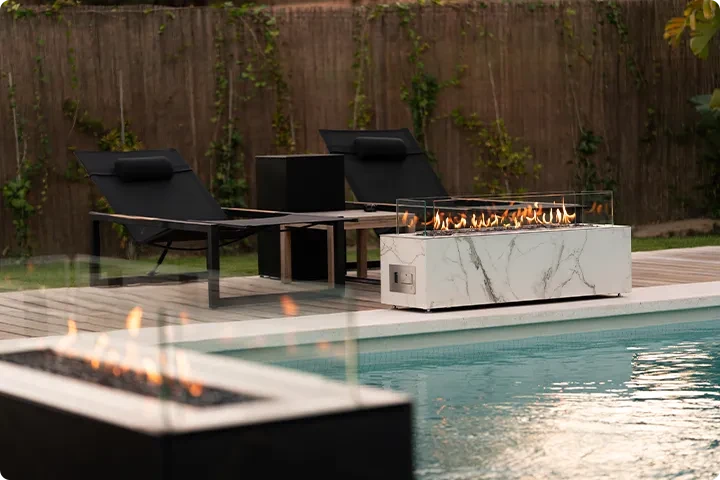
That era is over. European manufacturers have spent the past decade treating bioethanol fireplaces as serious design objects – and the results are striking. You can find ultra-slim wall panels that look like a piece of contemporary art until you realize the fire is real. There are double-sided tunnel designs that burn through the center of a room divider. Outdoor-rated units built from brushed steel and volcanic stone for terraces and garden walls. Compact tabletop burners for a dining table or coffee table that create intimacy without overwhelming a small space.
Brands like Cocoon Fires, Planika, EcoSmart Fire, and Foco – to name just a few of the better-known European names – have made this category genuinely exciting from a design standpoint. They collaborate with architects and interior designers, and their products show it.
Real flames, zero structural work – the apartment fireplace finally exists, and it looks considerably better than you might expect.
Renovation Projects Where a Flue Is Simply Not Feasible
Not every no-chimney situation involves renting. Plenty of homeowners face the same problem – a ground-floor extension built over a basement, a converted loft where the roof pitch leaves no room for a flue, a listed building where any structural change triggers a lengthy permissions process. Sometimes the building just says no, regardless of who owns it.
In renovation contexts, bioethanol fireplaces are increasingly specified by architects and interior designers as the practical answer. The installation footprint is minimal, the lead time for delivery is far shorter than any masonry or gas fireplace project, and the visual impact can be substantial – especially with larger built-in burner systems that can be set into custom-built surrounds and recessed into feature walls.
A contractor fitting a kitchen or bathroom extension does not want to coordinate a separate flue installation. A homeowner on a tight renovation budget does not want the added cost. Bioethanol removes that entire branch of the project tree.
Where to Find a Serious Selection – and Guidance to Match
The category has grown fast enough that the number of products available is, frankly, slightly overwhelming if you approach it cold. Tabletop or freestanding? Wall-mounted or built-in? What burner size do you actually need for your room volume? Which fuel gives the longest burn time per litre? These are real questions, and the answers matter if you want to be happy with what you buy.
One specialist worth knowing about is Biopejs-shop.dk, a Danish retailer with around 12 years of experience focused specifically on eco-friendly and chimney-free fireplaces. Their catalogue runs to more than 4,000 products across more than 50 European brands – Cocoon Fires, Planika, Dimplex, Foco, Morsø, EcoSmart Fire, and many others. They have physical showrooms in Aalborg and Copenhagen, plus one in London, which means you can actually see fireplaces burning in person before committing – something that matters more than you might think until you have stood in front of a live flame and understood the scale and warmth output firsthand. They also run an online video consultation service with in-house specialists for customers who cannot visit in person, and they ship to 14 European countries.
The ability to see a product burning in a showroom setting addresses one of the genuine challenges of buying a fireplace online: photographs and renders tell you almost nothing about how a flame actually moves or how a unit sits in a room.
.webp)
The Honest Verdict – Including the One Real Limitation
Bioethanol fireplaces genuinely deliver on the core promise. Real flames. Real warmth – modest but perceptible, especially in smaller rooms. Genuine design quality across many of the leading brands. And complete independence from chimneys, flues, gas connections, or structural work.
For apartment dwellers, renters, and renovation projects where traditional fireplaces are not viable, they are not a compromise. They are a better fit for the actual situation than trying to retrofit something that was never designed for it.
The one limitation worth being straightforward about: running cost. Bioethanol fuel is not free, and a larger burner running for several hours each evening adds up over a heating season. These fireplaces are at their best as atmosphere – a focal point, a complement to your main heating system, an evening ritual – rather than a primary heat source. If you are hoping to meaningfully reduce your energy bill, that is probably not this product’s job. But if you want real fire in a space where real fire was previously impossible? That, they do very well.
The apartment fireplace is no longer a fantasy. It just needs a different kind of fuel.
