



The USA Is Not a Cashless Utopia – And Your Budget Will Feel It
You’ve seen the travel posts. “America is card-only now!” “You barely need cash anymore!” People who write that usually visit Manhattan once and call it research. The reality – particularly if you’re venturing beyond the big cities – is far more complicated, and getting your money wrong from day one can quietly wreck a perfectly good trip. So let’s talk about what actually happens on the ground, what the exchange rate websites won’t tell you, and how to arrive with dollars that didn’t cost you a small fortune to obtain.
How Many Dollars Do You Actually Need?
This is the question everyone asks, and almost nobody gives a straight answer to. Here’s a rough framework that actually works. A solo traveler doing a two-week road trip through a mix of cities and smaller towns should budget around $80-120 per day in cash – and that’s before accommodation. That figure climbs fast in New York or San Francisco, and drops a little in the Midwest or the South. The honest answer is that your accommodation type matters more than your destination city. Staying in mid-range hotels with restaurants attached? Your cash spend drops. Renting a car and stopping at diners, roadside attractions, and state park entry booths? Cash is essential.
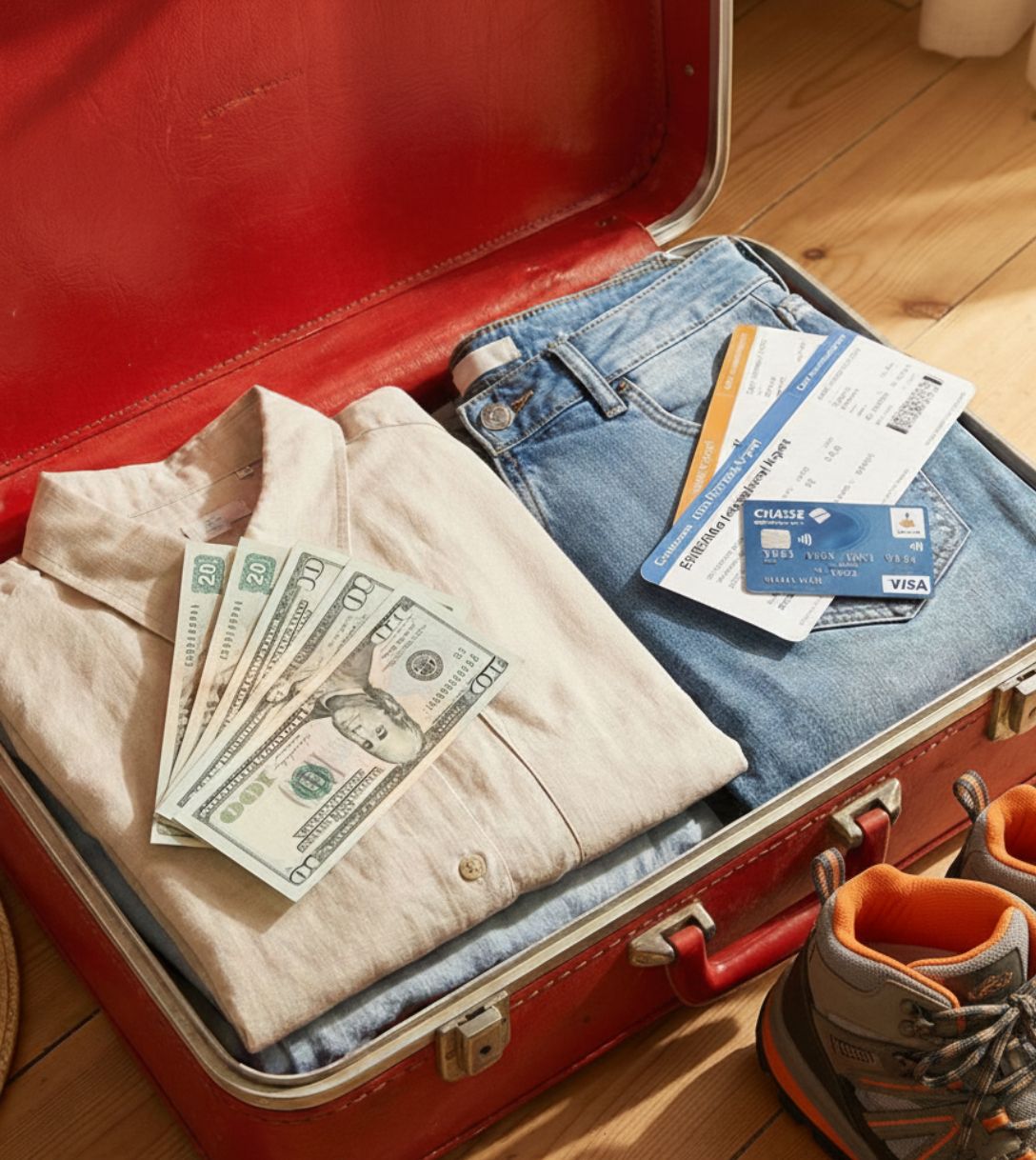
A common mistake is underestimating the cash-only moments that pop up unexpectedly. Farmers markets. Shuttle buses between airports and rental car lots. Luggage storage at train stations. Valet parking. Toll roads on certain routes. Beach chair rentals. Some of these take cards, sure – but many absolutely do not, and being caught short at a Florida toll plaza is the kind of low-grade misery you could easily prevent.
Tipping: The Silent Budget Killer That Exchange Rates Never Mention
Here’s the part that genuinely surprises first-time visitors to the USA. The sticker price is not the price you pay. Tipping culture in America is not optional, and it’s not just restaurants – it’s woven into almost every service interaction you’ll have. Get this wrong and you’ll look rude, feel awkward, and run out of cash faster than any exchange rate ever managed to drain your wallet.
The standard restaurant tip is 18-22% of the pre-tax bill. Not 10%. Not “a bit extra.” Eighteen to twenty-two percent, and that’s for ordinary service – bump it to 25% if someone goes out of their way for you. Hotel housekeeping: $3-5 per night, left on the pillow each morning (not a lump sum at the end, because the staff rotating changes daily). Taxi and rideshare drivers: 15-20%. Airport porters who handle your bags: $2-3 per bag. Bartenders: $1-2 per drink minimum, not a flat tip for the whole round. Hair salons, spa treatments, and massage therapists: 20% without flinching.
Do the math on a ten-day trip and you’re looking at $200-400 in tips alone, purely for expected service – not exceptional service. That’s money you need in small bills, in your pocket, constantly. Which brings up the next problem: getting hold of good-quality small denominations once you’re already there.

Why Airport Exchange Kiosks Are the Worst Deal in Travel
Airport currency exchange counters – the ones you see the moment you land, positioned perfectly to catch exhausted travelers who just want cash now – operate on rates that can be 8-15% worse than what you could have obtained before your flight. That’s not speculation. That’s the business model. Convenience is the product, and you’re paying heavily for it.
ATMs in US airports aren’t much better. Many charge a flat fee of $3-5 on top of whatever your home bank charges for international withdrawals, plus a currency conversion fee layered on top of that. And if the ATM offers to convert the amount to your home currency on the spot – decline. Always decline that offer. That “service” (called dynamic currency conversion) locks in a terrible rate on the ATM’s terms, not your bank’s.
The gap between a good rate obtained before travel and a lazy rate grabbed at the airport is real money. On a $500 cash exchange, you might lose $40-75 to a bad rate – which is roughly a decent dinner, a tank of gas, or an entry fee to an attraction you actually wanted to visit. The math makes itself.
The Case for Ordering Currency Before You Fly
This is where the approach shifts from reactive to smart. Ordering your dollars ahead of departure – at a guaranteed rate, with no commission eating into the transaction – means you know exactly what you’re getting before you’ve even packed your bag. No anxiety at the exchange counter. No squinting at a screen trying to calculate whether the rate shown includes the hidden fee.
Services like GWK Travelex have been built around this logic for nearly a century. Order online, collect same day at one of their locations across major Dutch train stations and airports – no queue, no scramble. Or choose next-day home delivery and have your dollars arrive at the door before your taxi does. The rate you see is the rate you pay. No commission. No hidden charges. For someone planning a US trip from the Netherlands, that kind of certainty is worth more than most travelers realize until they’ve been stung once by an airport kiosk.
- Restaurants: 18-22% of pre-tax total
- Hotel housekeeping: $3-5 per night (daily, not end of stay)
- Taxi / rideshare: 15-20%
- Airport porter: $2-3 per bag
- Bartenders: $1-2 per drink
- Spa / salon: 20%
- Tour guides: $5-10 per person for half-day, $10-20 for full day
Using Cards in the USA – What Works and What Doesn’t
Cards are widely accepted in the USA. That much is true. Visa and Mastercard work almost everywhere that takes cards at all. But “almost everywhere” still leaves a meaningful gap, especially when you’re traveling outside the main tourist corridors. Rural gas stations sometimes require a local zip code for pay-at-pump card transactions – something a European card can’t provide. Some accommodation providers at smaller inns and bed-and-breakfasts prefer cash. Certain attractions, particularly nature reserves and state parks, operate cash-only ticket booths.
A prepaid travel card with multi-currency support – the kind that lets you load USD before you travel, lock in a rate, freeze the card if it goes missing, and manage everything from your phone – is genuinely useful as a backup to your main card. It keeps your main bank account insulated from skimming risks, which is worth thinking about at busy tourist ATMs. That said, it is not a replacement for cash. Nothing replaces having actual dollars in your hand for the countless small transactions that make a US trip run smoothly.
Splitting Your Money: The Sensible Approach
Here’s a practical split that works for most USA trips lasting 10-14 days. Bring roughly 60% of your planned spend in dollars cash, and keep the remainder accessible via card. Within your cash, make sure you have a healthy supply of $1, $5, and $10 bills specifically for tips and small purchases – $20s are fine for larger transactions but can be awkward for the housekeeping envelope or the bathroom attendant who helped you out. Ask the exchange service to include smaller denominations when you order; most will accommodate this without fuss if you mention it.
Keep your cash split across two locations. One stash in your wallet for daily use, one backup in your accommodation safe or a hidden travel wallet. Losing your entire trip budget to a pickpocket on the New York subway is the kind of thing that happens to people who didn’t do this. And it happens more than travel blogs like to admit.
The gap between a good rate obtained before travel and a lazy rate grabbed at the airport can be real money – around $40-75 on a $500 exchange. That’s a dinner, a tank of gas, or an attraction you wanted to visit.
What Happens to Your Leftover Dollars?
This is something most currency guides completely ignore, which is irritating because it’s a real question at the end of every trip. You land home with $80 in your pocket and no idea what to do with it. Stuffing it in a drawer for “next time” works if you travel to the USA regularly – but if your next trip might be somewhere else entirely, unused foreign currency just quietly loses value as time passes.
Some currency exchange services offer a buy-back guarantee – meaning they’ll buy your unused dollars back at guaranteed rates, not whatever happens to be the rate that day. It’s the kind of protection that removes the mental overhead of trying to spend every last dollar before your flight, which rarely ends well and usually results in an overpriced airport sandwich you didn’t want.
The One Thing to Do Before Your Flight Boards
If there’s one concrete action to take away from this guide, it’s this: don’t leave currency exchange to the airport. Order your dollars online, at a guaranteed rate, with no commission, and either collect them before you depart or have them delivered to your door. The few minutes it takes to do this at home – versus the stress of navigating exchange counters with luggage in tow and a flight to catch – is one of those travel decisions that seems small and turns out to matter a lot.
One honest note: pre-ordering cash does require a little planning ahead. If you’re the type who packs the night before and decides everything last-minute, you’ll need to allow at least a day for home delivery, or plan a pickup at a collection point on your way to the airport. That minor time constraint is the only real friction in an otherwise straightforward process – and compared to getting a bad rate at 6am in a departure terminal, it’s a trade-off that’s hard to argue against.
The USA is an extraordinary place to travel. The scale of it, the variety, the sheer weirdness and brilliance of it – all of that gets better when the practical stuff is handled. Sort your dollars before you leave, keep small bills in your pocket, tip correctly, and you’ll spend your mental energy on the trip itself rather than the transactions around it. That’s the goal.
