


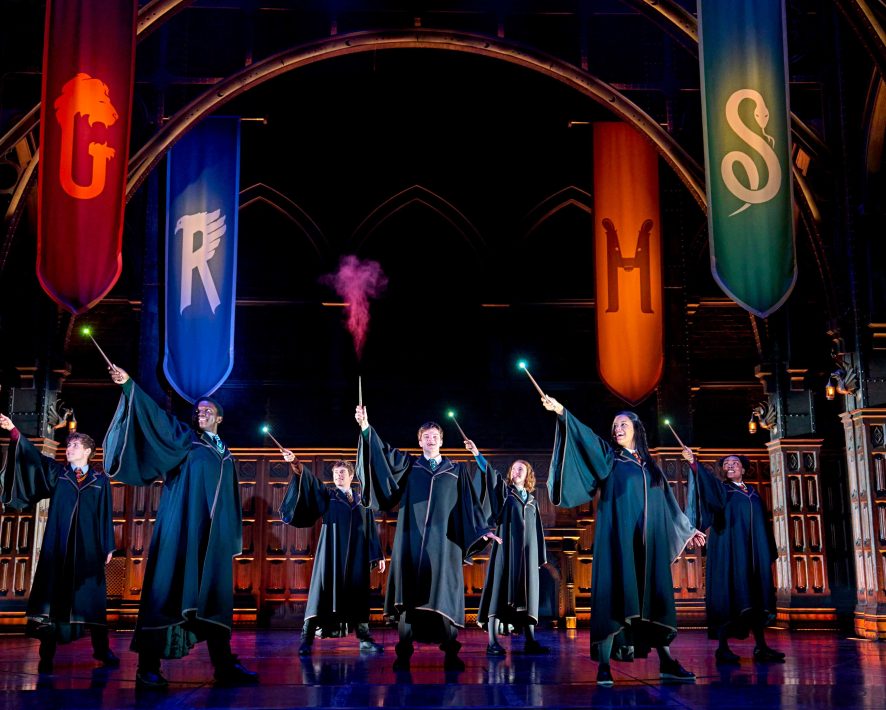
You’ve seen the films. You know the world. Eight movies, a theme park or two, probably a wand you bought at some point and still keep on a shelf. So when someone mentions Harry Potter and the Cursed Child, your first instinct might be to assume it’s more of the same – a polished, expensive retelling of something you already know inside out. That assumption is understandable. It’s also completely wrong.
What happens inside the Palace Theatre on Shaftesbury Avenue is something that the films – for all their visual effects budgets and technical wizardry – genuinely cannot replicate. Not because the films did it badly. Because the films were never designed to do what a live stage does. These are two fundamentally different kinds of experience, and the gap between them is wider than most people realise before they actually sit down in that auditorium.
The Screen Has a Frame. The Stage Doesn’t.
Here’s the thing about film and screen adaptations – they always have an edge. A border. A rectangle of glass or canvas that separates you from the action. Directors work brilliantly within that frame. They choose what you see, when you see it, how close the camera gets. That control is one of cinema’s great strengths. But it also means you’re watching something curated, filtered, at a remove.
Live theatre removes the frame. When something impossible happens on the stage of the Palace Theatre, it happens in the same physical space as you. The same air. The same room. There’s no cut, no camera angle adjustment, no post-production polish applied to make it look more convincing. What you see is what occurred. And your brain – which has evolved over hundreds of thousands of years to understand physical reality – knows it. That’s why the reactions in the Cursed Child audience aren’t polite applause. They’re genuine gasps. People grabbing the arm of whoever they came with. A room full of adults suddenly feeling like they’re eight years old again and something genuinely inexplicable just happened in front of them.
Why Illusions on Stage Hit Differently
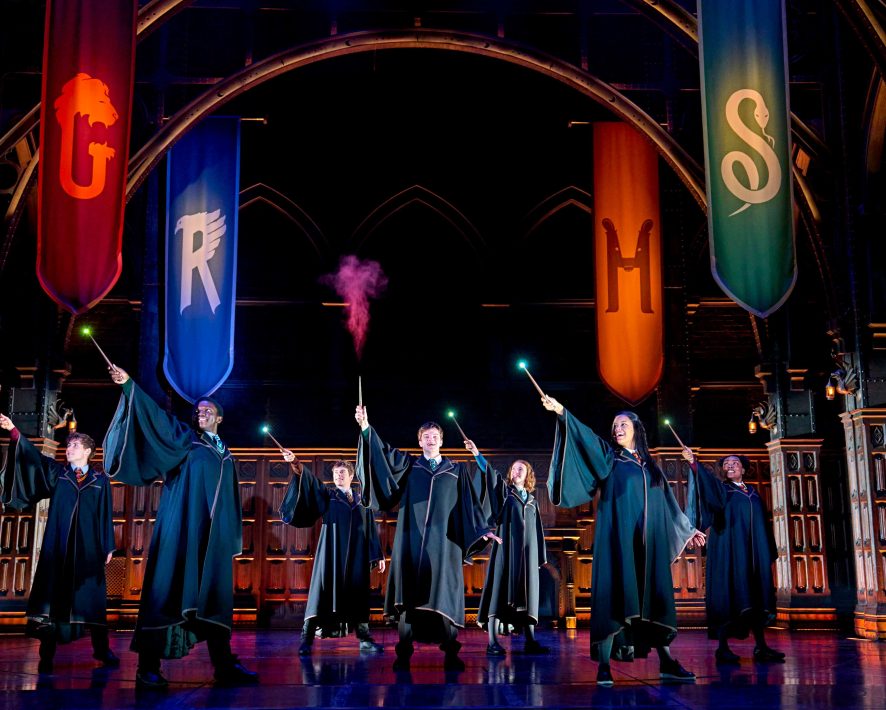
The production’s theatrical effects – and the creative team behind them has been extraordinarily careful never to reveal exactly how they work – achieve something that should, by any rational logic, be impossible. People vanish. Objects transform. Characters move in ways that defy physics. And because it’s live, because there’s no green screen or CGI compositor involved, because the performers are right there in the same room as you, the effect lands with a weight that no film sequence can quite match.
Critics have struggled to describe this properly for years. The Times used the phrase “magic happening before your eyes” – which reads as hyperbole until you’ve actually been there, and then seems like the most precise description imaginable. The honest truth is that good theatrical illusion exploits the same cognitive machinery that makes optical illusions work on paper. Your brain confidently fills in explanations, constructs a coherent story, and then that story turns out to be impossible. The difference from a film is that on screen you always have a ready excuse: it’s CGI, it’s a camera trick, it’s editing. In a theatre, none of those exits are available to you.
Your brain confidently fills in explanations, constructs a coherent story, and then that story turns out to be impossible – and there’s no screen to blame it on.
The Story Itself Earns This Treatment
It’s easy to focus on the spectacle – and the spectacle genuinely is spectacular – but the theatrical effects only hit as hard as they do because the story underneath them is doing serious emotional work. Cursed Child is the official eighth Harry Potter story, co-created by J.K. Rowling, playwright Jack Thorne, and director John Tiffany. It isn’t a retread. It isn’t nostalgia packaging dressed up as something new.
The play centres on Albus Severus Potter and his friendship with Scorpius Malfoy – a dynamic that the films never explored, because the films ended before it could begin. There’s a genuine father-son tension at the heart of this story that gives the whole thing emotional weight you didn’t know you were missing from the broader saga. The production has won nine Olivier Awards including Best Play, plus Tony, Helpmann, and Drama Desk awards across its international runs. That’s not the kind of trophy cabinet you accumulate by being a glorified theme park attraction. The awards reflect a production that takes its storytelling as seriously as its stage craft.
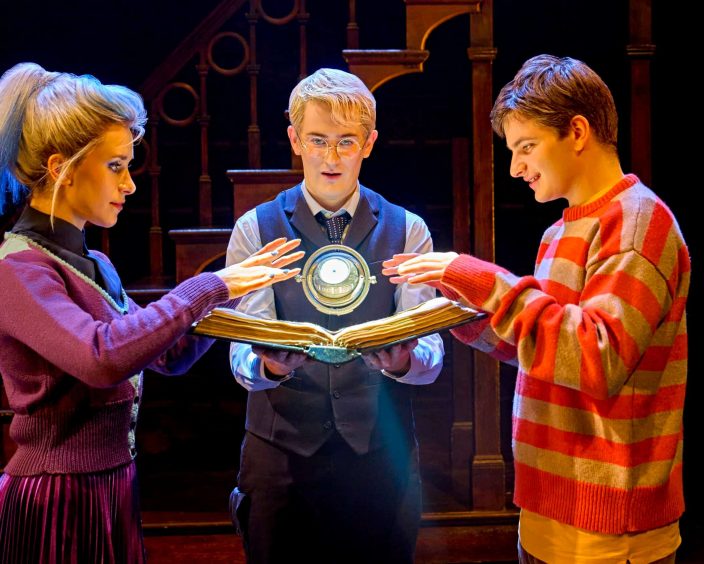
What a Streaming Version Simply Cannot Carry
Imagine, for a moment, trying to film one of Cursed Child’s key illusion sequences and release it on a streaming platform. The camera has to be somewhere. It has to choose a perspective. Once a camera chooses a perspective, the illusion either works from that specific angle – or it doesn’t. And the audience, watching from their sofas, will immediately start applying every screen-based explanation available to them.
They’ll wonder about the camera angle. They’ll look for the edit. They’ll assume there’s a compositing layer they can’t see. Even if the production somehow managed to preserve the effect’s integrity through a camera lens – which is genuinely doubtful – the sofa viewer would still be receiving it through a mediated screen, in a room full of familiar objects, probably with a phone nearby and a cup of tea getting cold. The psychological conditions for genuine wonder are simply not present in the same way.
In the Palace Theatre, the conditions are different. You’re in a Victorian building with gargoyles on the facade that tell you something unusual is happening before you’ve even bought your programme. The auditorium itself has been deliberately configured to maximise the sense of intimacy and immersion. The darkness is purposeful. The sound design wraps around you. Every element of the environment has been calibrated to make you receptive. And then, in that state, something impossible happens six metres in front of you.
The Triwizard Sequence – a Case Study in Theatrical Presence
Without giving too much away – and this is a production where spoilers genuinely diminish the experience, so consider this a soft warning – there are sequences in Cursed Child that revisit familiar moments from the original saga in ways that are transformed entirely by their live context. The Triwizard-related moments are a good example of this. You know the story. You’ve seen the film. And yet, watching the same events unfold on a stage, in real time, with real performers and practical theatrical effects happening in the same room as you, the emotional impact is categorically different.
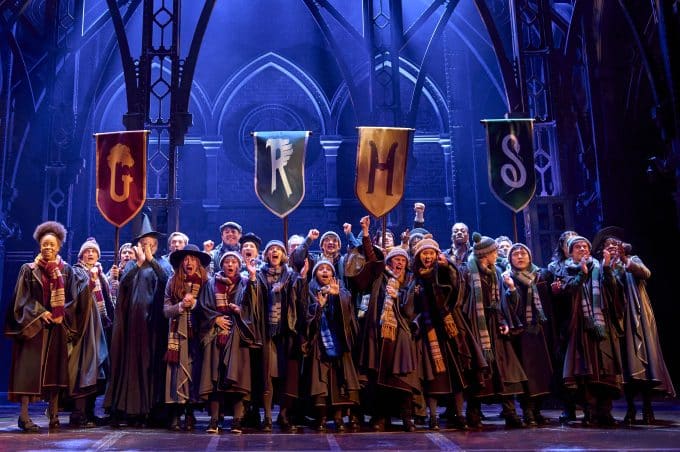
Familiarity doesn’t protect you, is what I’m trying to say. You think you know what’s coming. The play knows you think that, and it uses it. The theatrical effects in these scenes aren’t just impressive technically – they’re narratively precise. They happen at exactly the right emotional moment, in exactly the right way, and the live context gives them a weight that no filmed version could reliably replicate because filming would require choosing a single perspective on events that, in the theatre, surround you.
The Honest Part: One Genuine Caveat
This is the moment where intellectual honesty requires acknowledging something. The running time is substantial – the production is long, and while the pacing is generally well-managed, there are stretches in the first half where the emotional investment takes time to build. If you go in expecting the pace and propulsion of a film, the theatrical rhythms might initially feel slower than you anticipated. This is theatre, and theatre breathes differently from cinema. Most people find, by the interval, that the investment has paid off completely. But it’s worth knowing beforehand that the first thirty minutes or so ask more patience from you than the films ever did.
That’s the flaw. It’s a real one. And it doesn’t change the fundamental truth that what you experience in the second half of this production – or across both parts if you attend the full two-part staging – is something you simply cannot access anywhere else. Not through streaming. Not through recorded footage. Not through the most detailed written description. The live theatrical context isn’t just a delivery mechanism for the story. It is, in a meaningful sense, part of the story itself. The magic works because it happens in the room. Remove the room and you remove the magic.
Why This Particular Moment Matters
There’s a broader cultural point worth making here. We live in an era of extraordinary on-demand access to filmed content. You can watch almost anything, almost anywhere, almost instantly. That access is genuinely valuable. But it also creates a quiet assumption that live experience is somehow redundant – that if something can be filmed and streamed, the live version is just the premium version of the same thing, useful mainly for social cachet or bragging rights.
Cursed Child challenges that assumption directly. Not because it’s trying to make a philosophical point about theatre vs. cinema – the creative team isn’t interested in that debate, they’re interested in telling a great story brilliantly. But the production has stumbled onto something true: there are experiences that fundamentally require physical presence to work. The theatrical effects aren’t impressive despite being live. They’re impressive because of it. The presence is the point. And no filmed, streamed, or described version of this show will ever quite convey what it feels like to be in that room when something impossible happens in front of you, with no screen to blame it on and no camera to hide behind.
Some things you really do have to see for yourself.
