


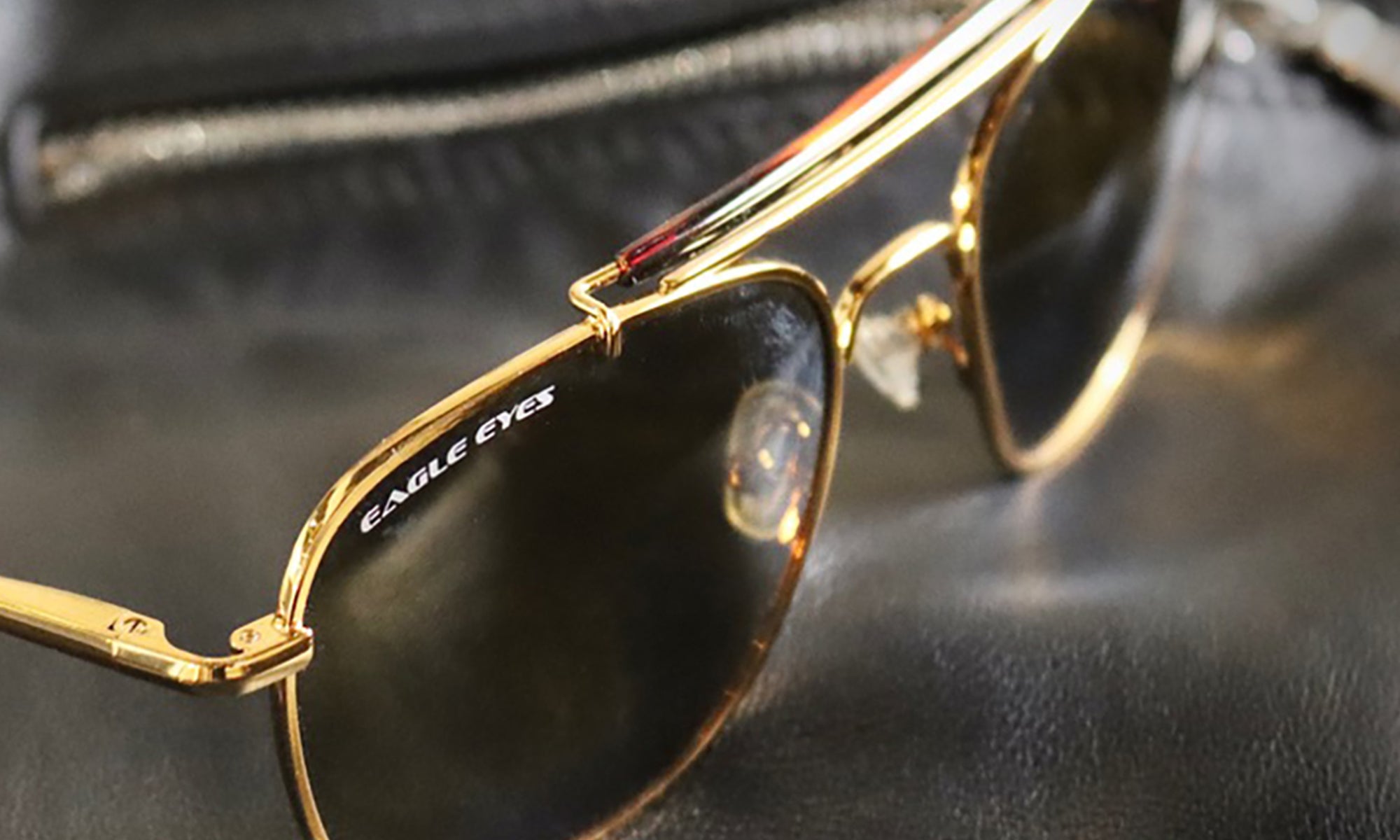
Most sunglasses are furniture for your face. Nice to look at, fine for squinting at a patio menu, and essentially useless when it comes to the science of what actually happens to UV radiation the moment it hits your eyes. That is a bold statement – and honestly, I was skeptical before I started digging into Eagle Eyes and their TriLenium lens technology. A brand claiming NASA roots? Sounds like marketing. Turns out, the story is genuinely worth understanding.
Where It Actually Starts: Eagles, Retinas, and NASA
Here is something most people do not know about eagle eyesight. Raptors possess colored oil droplets inside their cone photoreceptors – tiny filters, essentially, sitting right inside the retinal cells themselves. These droplets cut short-wavelength light (the UV and high-energy blue range) before it ever reaches the photosensitive layer underneath. The result? Eagles perceive the world with dramatically reduced glare and enhanced contrast, particularly against bright skies and open water. Nature solved the UV problem millions of years before humans even thought to wear sunglasses.

NASA optical researchers noticed this biological mechanism during studies on visual performance in high-radiation environments – the kind astronauts face in low Earth orbit, where UV intensity is many times higher than at sea level. The research question was straightforward: could synthetic lens coatings replicate what eagle oil droplets do naturally? Early astronaut eyewear incorporated these principles, filtering specific wavelength bands while preserving the color fidelity needed for instrument reading and navigation. That research lineage is exactly what Eagle Eyes eventually commercialized under the TriLenium name.
What 99.9% UV Blockage Actually Means in Optical Terms
You have probably seen “UV protection” on every pair of sunglasses at every pharmacy checkout counter. It means almost nothing without a number attached. The ultraviolet spectrum splits into three ranges: UVC (100-280 nm) is largely absorbed by the atmosphere before reaching ground level. UVA (315-400 nm) penetrates deeply – through clouds, glass, and ordinary lens tints. UVB (280-315 nm) is the higher-energy range behind photokeratitis, which is essentially a sunburn on your cornea.
Claiming 99.9% blockage of both UVA and UVB is a specific, measurable assertion – verified via spectrophotometry by shining calibrated light through the lens at each wavelength and measuring transmittance. Generic “UV protection” lenses without certification numbers often allow transmission in the near-UV band around 380-400 nm, which still carries enough energy to cause cumulative retinal damage. That gap matters more than most eyewear marketing lets on.

Three Technologies, Three Different Problems
What makes Eagle Eyes an interesting optics case study rather than just another sunglass brand is the decision to engineer three distinct lens platforms rather than one “universal” lens that does everything adequately and nothing particularly well. Each addresses a different lighting scenario – and the mechanisms behind them are genuinely different.
TriLenium: The Outdoor Core
TriLenium lenses are the flagship – the ones that carry the NASA lineage most directly. A multi-layer filter system blocks the UV bands described above while enhancing contrast in the visible spectrum. The eagle-eye analogy holds: the colored oil droplet principle translates into selective wavelength filtering that suppresses high-frequency blue scatter causing haze and visual fatigue outdoors. Colors read cleaner. Edges look sharper. You are not squinting against a wall of undifferentiated bright light – you are seeing a scene with perceptual layers.
Polarization layers are integrated into most TriLenium outdoor models. Polarized filters work on a fundamentally different principle from UV coatings – they are not about wavelength at all. Light reflected from flat horizontal surfaces (water, roads, cars) becomes polarized, meaning its waves align in a single plane. A polarized lens blocks that horizontally-aligned reflected light. Glare is gone. The scene underneath – lane markings on wet asphalt, a fish below the water surface – becomes visible without the overall darkness of a heavy tint.
Night-Lite: Scotopic Vision and Glare at Low Light
Night driving presents a completely different optical challenge. Your pupils dilate in low light, increasing susceptibility to scattered halos and starbursts around oncoming headlights. Standard dark sunglasses are obviously wrong here – they reduce overall luminance and make the road harder to see. Night-Lite lenses use a selective anti-scatter coating targeting the specific wavelengths responsible for glare halos without reducing the dim ambient light your visual system needs for road perception. The tint is typically amber or yellow, filtering the blue wavelengths scattered most aggressively by LED headlight spectra while transmitting the longer wavelengths that carry useful spatial information. Is it perfect? No – no lens entirely eliminates halos from high-intensity LED sources, which have a hard spectral spike that resists filtering. But reducing the worst scatter matters for reaction time and fatigue on long night drives.
Digitec: Blue Light and Screen Exposure
The Digitec platform addresses the indoor-screen environment – an eye-strain problem that is categorically different from both UV and night glare. Digital screens emit light peaking in the 415-455 nm blue range, which is the same high-energy visible light band implicated in disruption of melatonin signaling (via the ipRGC cells in the retina that drive circadian rhythm) and in the accelerated fatigue associated with prolonged screen sessions.
Digitec lenses apply a coating that selectively absorbs this near-UV blue band – a proper cut-off profile rather than a broad yellow tint. For people spending eight or more hours in front of monitors, the difference in end-of-day fatigue is often noticeable, though research on long-term benefits of blue-light filtering is still developing. That is the honest caveat here.

The 3-in-1 Concept: One Frame, Three Optical Environments
The SuperSight 3-in-1 system ships a single frame with interchangeable lens configurations – typically a daytime polarized TriLenium lens, a Night-Lite lens for driving after dark, and a clear lens for low-light or indoor use. This is not a marketing gimmick about versatility. The genuine engineering argument is that optimal eye protection requires different optical tools for different environments, and carrying three purpose-built lenses in one frame is more practical than owning three separate frames.
Proper interchangeable systems require precise frame-lens registration to maintain polarization axis alignment and a clear peripheral field. When the engineering is right, swapping lenses takes seconds. That is a more honest solution to the multi-environment problem than owning a separate frame for every lighting condition.
Why Most Fashion Sunglasses Do Not Compete on This Level
Fashion sunglasses are predominantly tint-first products. The lens color is chosen for aesthetics, a UV coating is applied to meet regulatory minimums, and optical quality is whatever the manufacturing cost allows. That is fine for a pair you wear twice a year at the beach. It is genuinely inadequate for daily use by someone who drives regularly, works outdoors, or spends most of their day in front of screens. The difference between a purpose-built optics product and a fashion accessory with a UV sticker is the difference between an instrument and a decoration. Eagle Eyes, through its TriLenium lineage and the three-platform approach, positions itself as the instrument – and the optical science behind that claim is real and verifiable in a way that most sunglass marketing is not.
The eagle-eye principle translates into selective wavelength filtering that suppresses high-frequency blue scatter causing haze and visual fatigue – colors read cleaner, edges look sharper.
One Honest Limitation Worth Naming
No lens platform, however well-engineered, eliminates all eye stress. TriLenium lenses excel outdoors in high UV conditions – they do not replace prescription correction, and they do not address muscular fatigue from prolonged near-focus reading, which has nothing to do with light spectrum. If that is your problem, no sunglass technology solves it. Understanding what a technology actually does is how you evaluate it honestly.
That said, for the specific problems these lenses target – UV-driven retinal stress outdoors, headlight scatter at night, and screen-driven blue-light fatigue – the engineering rationale behind Eagle Eyes is more substantiated than most eyewear products at similar price points. The NASA origin story is not just a tag line. It is the actual history of a research program that solved a real problem for astronauts and then found its way into consumer products. Learn more at Eagle Eyes MX.
